Why would Gustav and Johanna leave Norway?
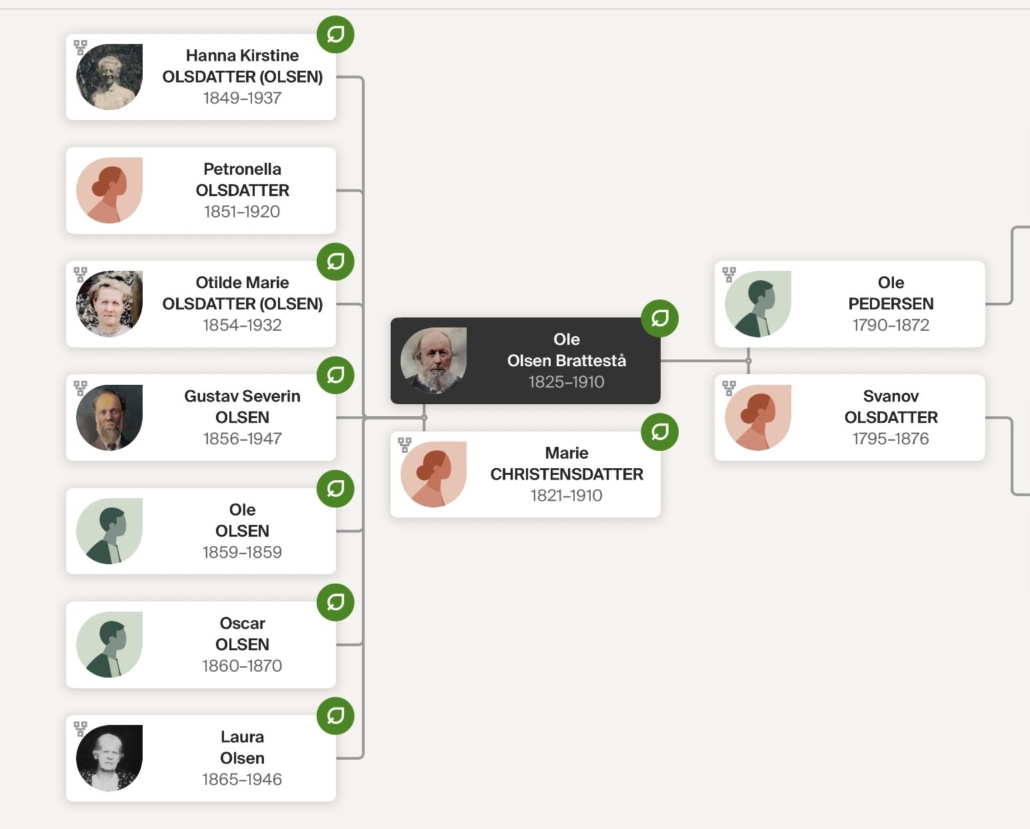
Family Group: Ole Pederson and Svanov Olsdatter
There were a number of compelling reasons that were non-negotiable for Gustav Olsen: paucity of land, religious freedom, diminished social status, and relatives that sent favorable news from America. These reasons are worth exploring because they really drove the direction of Gustav and Johanna’s lives in America and are the primary reasons they ended up in Humboldt County, California.
I. LAND
For centuries our ancestors lived in a region called Saude, located in Telemark county. Our Norwegian cousin, Barbro, built an extensive family tree where almost all of our ancestors lived in Saude. Rane Steinulfsen was the most distant, born in 1377. An earlier post described the Norwegian naming system, here is an example from our tree that is particularly tongue-twisting for Americans: Halver Torbjørnson, father of Torbjørn Halvarsson, father of Tone Torbjørnsdatter, mother of Rolleiv Torsteinson (born 1510). The stone church they likely attended was built in 1180. Originally Catholic, it became a Lutheran State church in 1539.
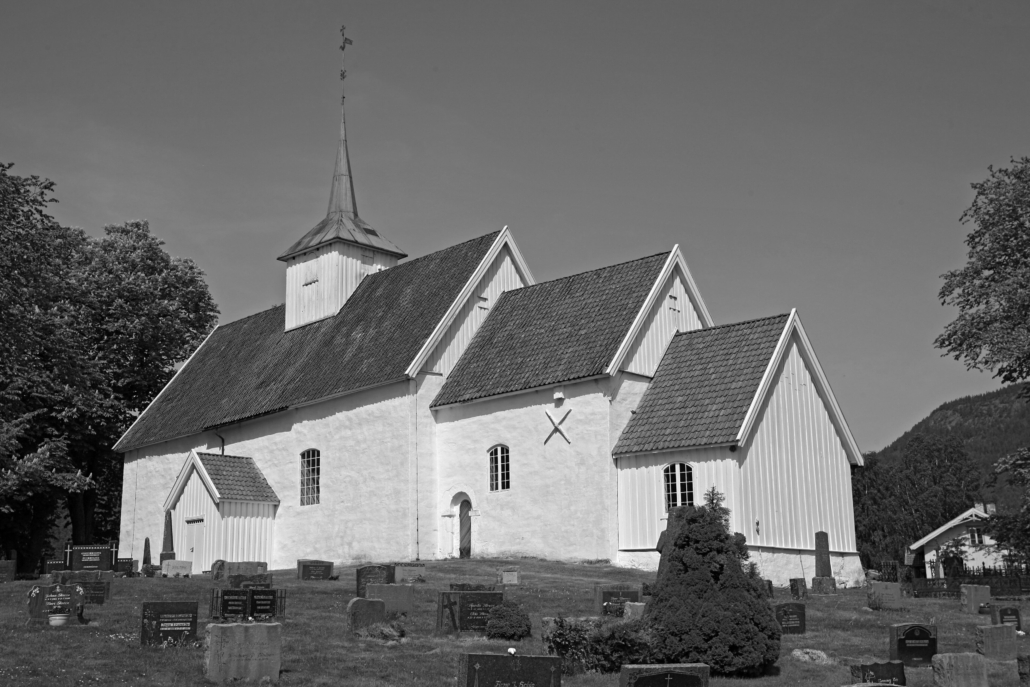
Saude Kirke, Wikipedia
A quick glance at the photo below reminds me of Humboldt County, but the setting is modern day Saude (now called Sauherad). In 1837 the population was beginning to explode due to the availability of inexpensive nutritious food, better hygiene resulting in lower infant mortality, and absence of wars. The area became a pressure cooker. Less than 3% of Norway’s land was suitable for plowing and raising crops and in addition the practice of the oldest son inheriting the land left the other children to fend for themselves. Land became hard to acquire.
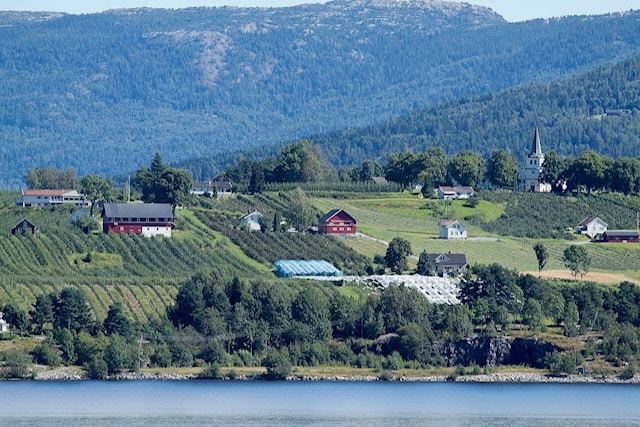
Saude (Sauherad) today. Wikipedia
In search of better opportunities, Gustav’s great-grandparents, Ole Peterson and Svanov Olsdatter along with their six children moved 27 miles east to the Toldnes farm near Skien. The photo below shows the outbuildings of a nearby farm. Notice the rocks.
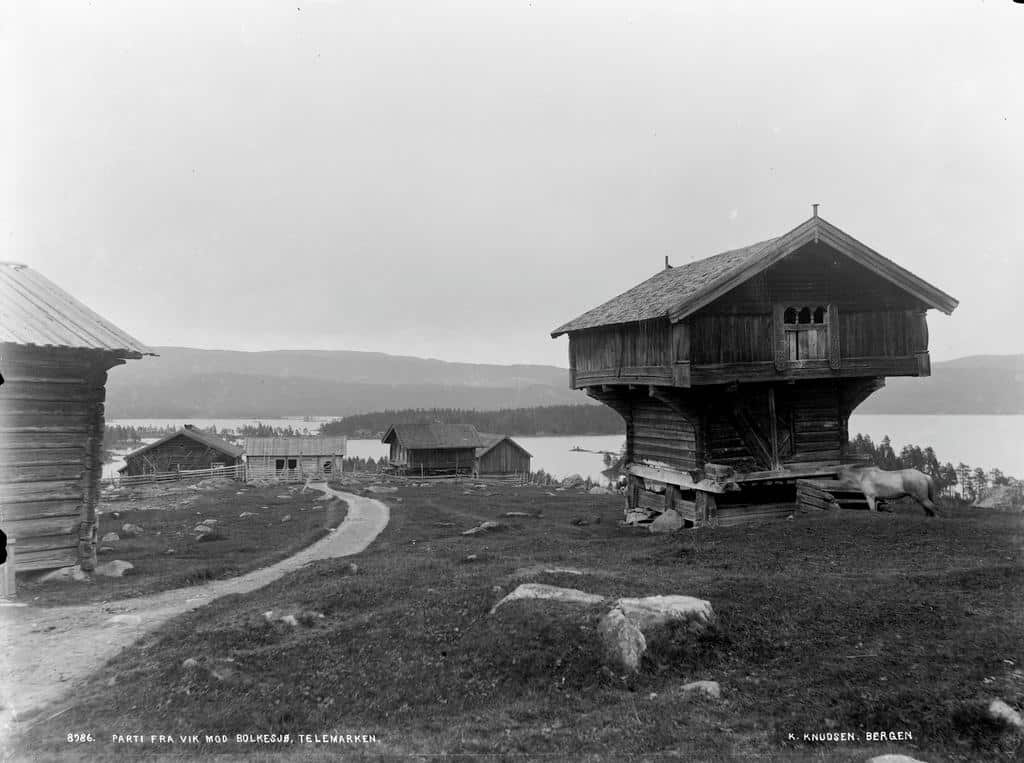
Farm outbuildings in Telemark. Photo by Knud Knudsen, Bergen University Library.
The 1865 Census shows that Ole and Svanov and their adult children and their families lived on a sub-section of Toldnes farm. The entire farm was home to 25 families and over 130 people These farms bore no resemblance to farms in Humboldt County, nor did they serve the same purpose. Residents of Toldnes farm would be the landowner(s), tenant farmers who may have leased the land for life, and “husmann” who were tenant farmers who may have owned the house but not the land and probably had no lease. Our family’s six heads of household were all hussman while their father, Ole Pederson, was a “gaardbruger” , a title indicating a higher social status and in his case, almost certainly included land ownership.
In Norway, land and assets were inherited by the oldest male in the family leaving the rest of the children without many resources. Our Ole Olsen was the youngest brother of Ole Olsen. This is not a typo, they had the same name! Since Gustav’s father, Ole Olsen (Brattestå was added for clarification I suppose) was the youngest son of Ole Pederson there wouldn’t be much left for his family. Gustav would have to find some other means to support himself. The 1865 Toldnes husmann were shoemakers, builders, loggers, laborers, woodworkers, servants, housewives, sawyers, farmers, seamen or ship’s captains. One 87 year old woman who lived by herself was listed as a pauper. Gustav’s fifteen year old older sister, Hanna, worked in the household of one of the farm owners as did her aunt, Pedronella. Fortunately for Gustav, a close neighbor was a ship’s carpenter and a large wooden ship building company was close by. This would prove fortunate for Gustav and would change the course of his life. Norway was about to become the third largest maritime mercantile nation, behind England and America. Gustav’s work would be his ticket to America.
Finally, let me share my favorite photo of a farm in Norway —NOT a Telemark farm but a Nordland farm and the buildings and clothing are not in the Telemark style. What is notable about the photo is that people seem to be a family unit. There are a lot of children dressed like miniature adults with parents/uncles/aunts near. Look closely and you’ll see an older man —likely a grandfather—in one of the doorways. There are two women in other doorways, one with an infant in her arms. Some people are looking at the camera but one male seems to be fixing something on the side of another man’s face — a sign of familiarity. In 1865 Gustav would have lived with a large multi-generational group like this and in 1881 he would leave most of them behind. It could not have been easy.
Footnote: Did you notice the rocks? Our cousin Elsie and husband, Terje, didn’t use a backhoe or shovels to level the foundation for their modern house, they used dynamite!
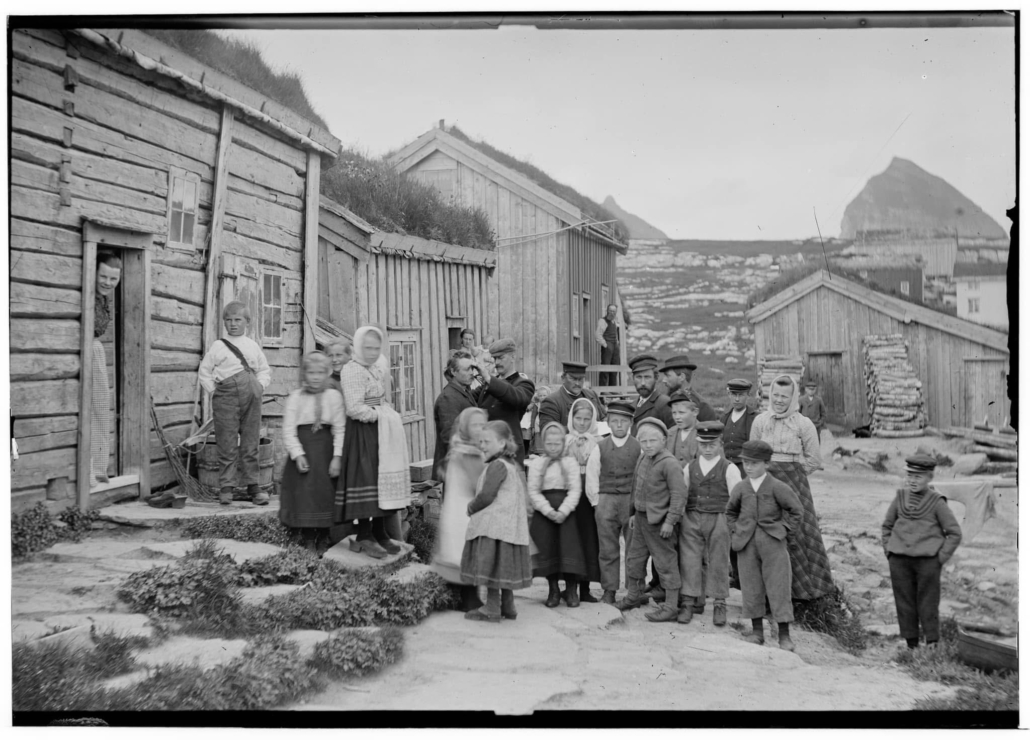
Family Farm Group in the North of Norway, https://www.digitalarkivet.no/en/content/start-genealogy
Sources:
Norwegian Migration to America by Theodore Christian Blegen, p. 5
Norwegian Farmer Groups by Johan I. Borgos