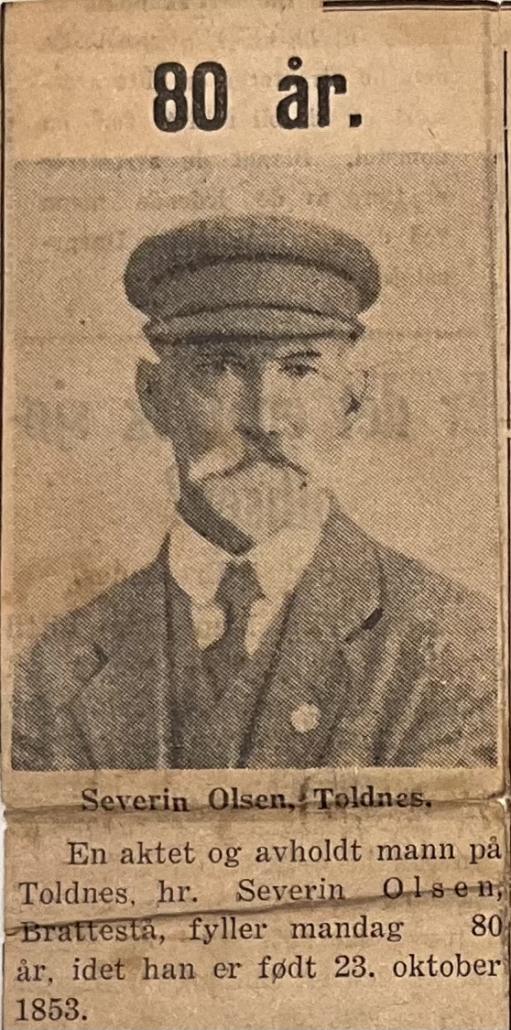
Severin Olsen, first cousin of Gustav Severin Olsen
This newspaper clipping is one of the treasures from Gustav’s box of Norwegian/Swedish photos. The man is Gustav Severin’s first cousin, son of the elder Ole Olsen, and in 1933 he was celebrating his 80th birthday. It establishes the fact that their grandfather, Ole Pederson, was indeed a land owner. Following is a summary:
80 Years
Severin Olsen, Toldnes
A respected and well-liked man at Toldnes, Mr. Severin Olsen Brattestå, celebrates his 80th birthday on Monday, having been born 23 October 1853.
Not only because of his advanced age has Mr. Olsen attracted our interest, but also because he is probably the oldest native-born resident of Toldnes. He was born there and has spent his entire life at Toldnes.
For that reason, Olsen can tell many interesting stories about the place, its families, and its buildings. He has followed Toldnes through its many changes and stages of development. From the few farms that existed there in his childhood, it has grown into a small community with several hundred inhabitants.
Olsen’s family comes from Nesherad (Sauherad), from a place called Brattestå. His grandfather (Ole Pederson) came to Toldnes in 1836, when he purchased the farm Moen, which lies beside where Olsen now lives.
Olsen’s father (Ole Olsen, Gustav’s uncle) established a small holding—a parcel of Moen—called Frydenlund, in 1857. It was here that Olsen(Severin) was born, and here he has always lived.
So….Gustav Severin’s grandfather owned land but Gustav’s father, the younger Ole Olsen, due to the traditions of the time was not likely to inherit the farm.
Prior to Gustav’s departure to America in 1881, the only people who could vote were male landowners, church officials, high level civil servants, and men who paid above a certain level of taxes. The 1865 census states that Gustav’s father, the younger Ole Olsen, was a farmer not a landowner and probably could not vote. His uncle and cousins were of a higher status and could vote. At that time it was very difficult for someone to climb up the social ladder or improve oneself, but Gustav managed to do this because:
- He could read. Reading proficiency was mandated in 1739. The ability to read was almost universal in the early 1800’s. The schools were decentralized and rooted in the church to prepare students for confirmation in the State Lutheran Church. When he left Norway he insisted on learning English and didn’t want family members speaking Norwegian— they were Americans. In Humboldt County he helped build and was a trustee of the first log schoolhouse built on the Hyampom Trail.
- He lived in a region that was a hotbed of anti-monarchical and working class dissent. One of the first political mass movements took place in the 1850’s in nearby Drammen, Skien, and Porsgrunn where workers demanded universal male suffrage and better rights for rural laborers. This new movement deeply affected him. In America for most of his adult life Gustav registered as a Socialist; he hosted Eugene Debs meetings in his Eureka, Humboldt County home. He held very strong opinions and I don’t think I’d going too far out on a limb to say that his descendants also have the same passion for issues and causes.
- He could find employment in the burgeoning shipbuilding industry in Skien and Porsgrunn. Gustav eventually became a ship’s carpenter—an occupation that was highly valued in the district. Ships from the area sailed to ports in Europe carrying timber products as you can see in the photo below.These full-rigged ships had 3 masts and could undergo long ocean voyages. Notice the logs in the foreground, warehouses lining the waterfront, and log booms floating upstream. This area was famous for its timber. Also notice the two parallel walls used to hold ships while they were being built. When completed they would travel down the slip into the water, head down the river, travel through a fjords and straits and into the sea.
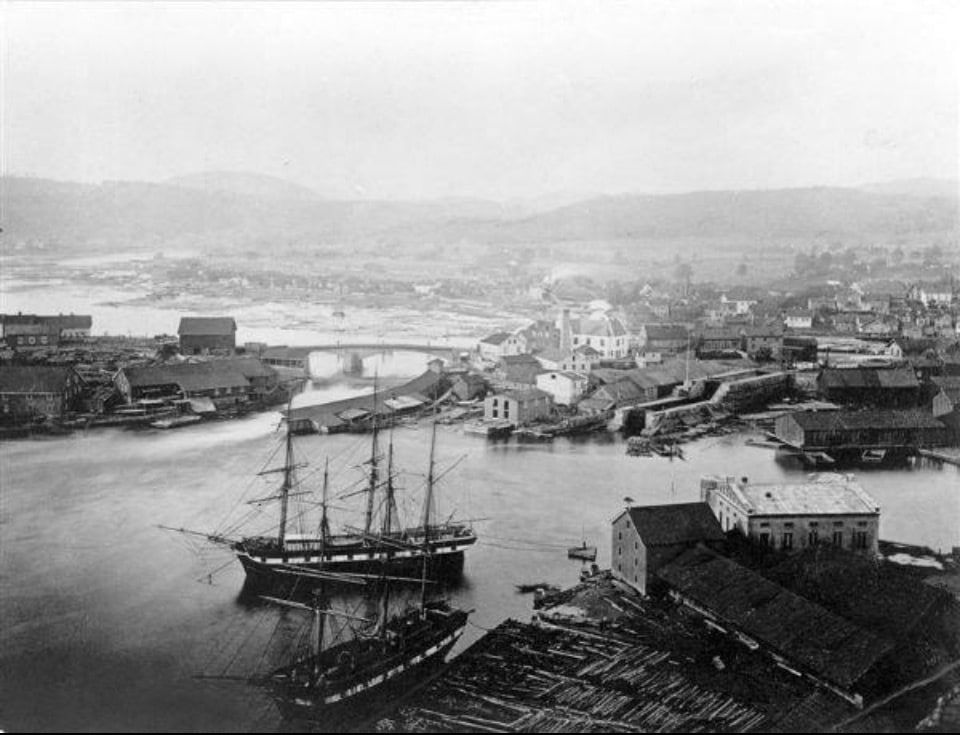
1870’s shipbuilding in Skien or Porsgrunn
However, I know Gustav had his sights set on America. He would soon start sailing out of Bergen—a cosmopolitan city with centuries of international trade, including North and South America.
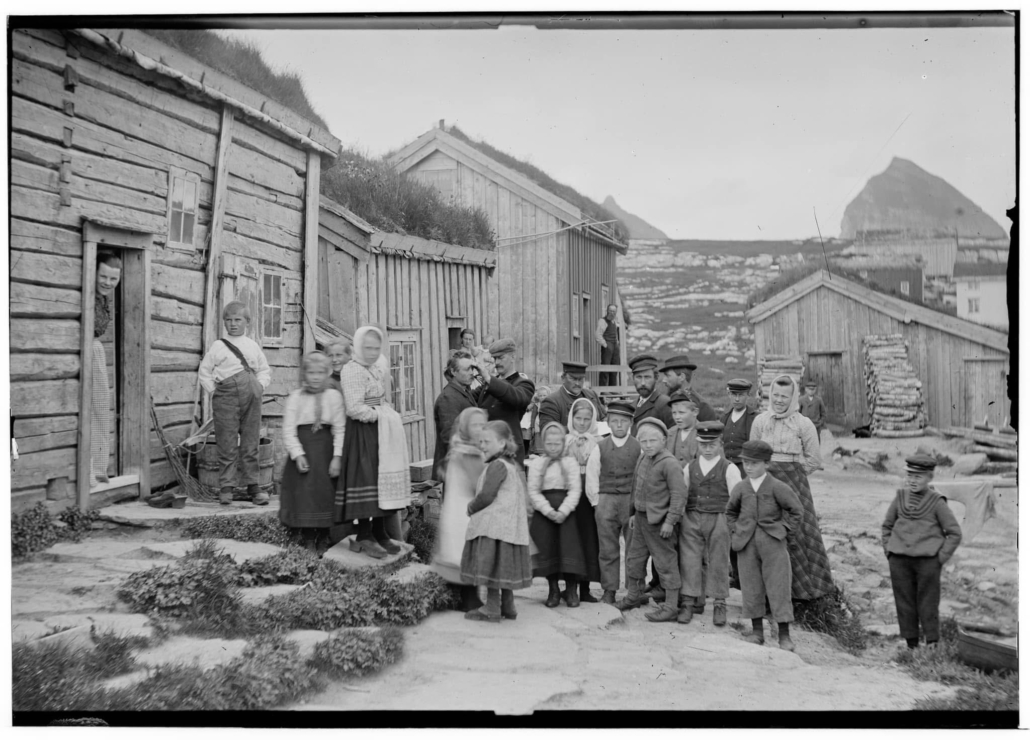
Finally, a note about Norway’s Constitution Day that occurs every May 17. After centuries of Danish rule, Norway won its independence on May 17, 1814 when they wrote their first constitution. However, they were forced to be in union with Sweden. King Carl Johan didn’t think it was a good idea to celebrate Norwegian “independence” after 1814 and banned gatherings. The ban ended in 1836 and in 1864 the tradition of children marching in parades began. I imagine this was important to Gustav because this photo of children in Porsgrunn was sent to him by a niece in the 1930’s. Norway wouldn’t separate from Sweden until 1905, almost 25 years after he and his small family left Norway.
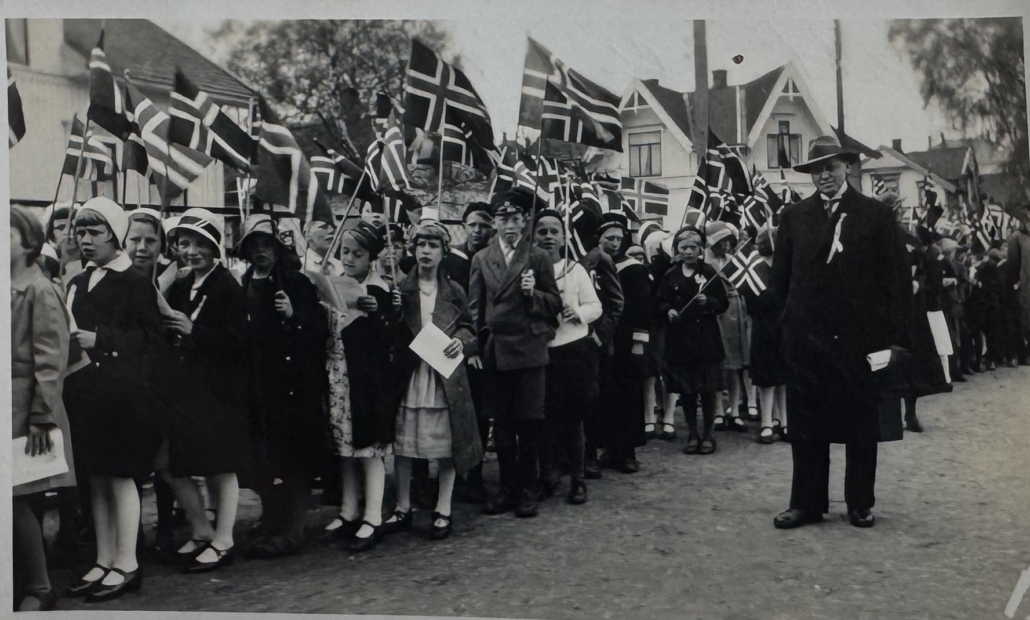
Porsgrunn, May 17 Celebration, 1930’s